Bob Hannum Polishes Historic Markers in Time for the 250th

design_1164421_26862579_3962546_sourcefile_03 (3)
  • Home
  • About
  • Services
    • Framing
    • Restoration
    • Fabrication
    • Installation
    • Research
    • Support
    • Pro Bono
  • Contact

Sculpture Restoration for Williams College

February 12, 2017 by Bob Hannum

What Began as an Installation Became a Restoration


Uh Oh, Something's Missing!

Arts Management Services LLC (AMS) installed a sculpture from the collection of the Williams College Museum of Art.

1 week installation in 1.5 minutes!

It's a sculpture by the environmental artist and architect Michael Singer entitled Ritual Series 1990 now on exhibit through February 19, 2017. It's the centerpiece of a group exhibition titled 'Shaping Space,' which also includes works by Richard Serra, Mel Edwards, and Louise Nevelson. To learn more about this exhibition, visit the Williams College Museum of Art (WCMA).

During the installation I discovered that a few pieces were missing much to the chagrin of the artist and museum staff. After an extensive search the pieces were not found. Michael Singer determined that the sculpture looked fine to exhibit, but that the missing pieces should be restored. So WCMA commissioned AMS to restore the missing pieces. My son William joined me and we completed the project and replaced the missing pieces on February 7.

Acquisition

Arts Management Services assisted in the original fabrication of this sculpture in the early '90's.

Related Projects:
Restoration in Istanbul
Art Restoration in Manila
Conservation of the Buddha
Sculpture Restoration in London
Sculpture Installation in Athens
Restoration at the Denver International Airport

Williams College in Williamstown, Massachusetts added this sculpture to their permanent collection as a gift from an alumnus and closest friend of the artist, Dr. William Fishkind.

About the Sculpture

Ritual Series, 1990 consists of wood, granite, field stone, copper and bronze measuring 230″ x 230″ x 75″ tall.
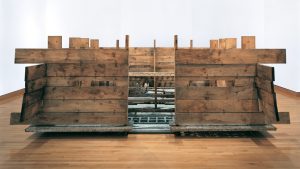
Williams College restoration 1The wood has a gorgeous texture created by sand-blasting 2″ thick rough-cut pine, harvested from the woods nearby Michael's Vermont studio by a local mill. After sand-blasting, the large and heavy planks were carefully singed to create an ancient look. The wood is not coated and easily bruised so handling is careful with gloves at all times. Likewise packing and storage is done with special care to avoid bruising or scratching the soft wood.

Field stone was collected from around the artists 100-acre property in the mountains of southern Vermont. Mr. Singer would assemble a group of us from his studio and line us up behind him in a single row. We would then follow him all over his fields like ducklings. He would point to a rock and one of us would pick it up and carry it. Most were too heavy to carry more than one. When we all had one we would load them on his pickup truck and transport them to be cut flat on one end.

Holes were drilled into the planks. These holes refer to the aboriginal maritime culture of the Chumash who lived along the coast of what is now California. They created their canoes by lashing planks together which they referred to as Tomol, which was the original name of this artwork when first exhibited outdoors in a dry riverbed of the Santa Barbara Botanical Gardens.

Another interesting feature is the 'barrewood' and the barrewood patterns reflected in some of the bronze elements. Barrewood is a term used by the artist because these distinct patterns are created by huge saw blades that cut thru granite and slightly into 2 x 4 planks that line and protect the floor. Michael's stone cutters are located in Barre, Vermont.

The Installation
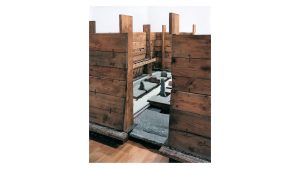
Williams College restoration 2One of the secrets of this artist's work is the precise degree of vertical plumb and horizontal level. Most good carpenters notice when something is off-level by anywhere from an 1/8″ to 1/4." Incredibly, Mr. Singer notices pieces that are off-level by only 1/32″! This precision creates a subliminal effect of calm and quiet, making the heaviness of stone, metal and thick wood seem light, floating, contemplative, even otherworldly. This stunning effect can be felt in this and many of his other sculptures. Many of the granite and bronze pieces are heavy and the long and thick pine planks bulky, needing 2 to handle and place precisely according to the instructions.

Our team devised an instructional system with carefully marked photographs whereby intricate sculpture such as this can be assembled and disassembled by museum and gallery preparators. This art installation required two people five days to install. This is only the second showing of this sculpture at Williams since it's purchase and exhibition in 1990. The current exhibition notes this about the artist and this work:

In 1971, Michael Singer fled New York City and settled in rural Vermont, where he found solace and renewed inspiration in nature. Comprised of sculptures and landwork, much of Singer's body of work exists outside of traditional art spaces. In his architectural designs, gardens indoor and outdoor artworks, and infrastructure projects, he consistently endeavors to produce ecologically sustainable objects and spaces that draw inspiration from their particular environment. This sculpture is part of Singer's ongoing Ritual Series, a collection of indoor installations crafted using an array of natural materials. Curved wooden beams enclose a labyrinthine interior of stone, metal, and wooden forms. For Singer, this central sanctum is akin to an inner realm - a sacred space from which to contemplate one's place in the natural world.

Filed Under: Restoration Tagged With: Art Restoration, Arts Management Services LLC, Michael Singer, Robert Hannum, sculpture restoration, Williams College Museum of Art

Sculpture Installation for Michael Singer

June 2, 2016 by Bob Hannum

New Project for the Environmental Artist Michael Singer

The Met!

Sculpture Installation for Michael Singer

'First Gate Ritual Series 1985', ash, cut granite, and field stone.

My team and I, joined by our newest member, my son William, just embarked on a challenging project.

Michael Singer commissioned my company Arts Management Services LLC to remove several of his sculptures that are currently installed in his private gallery, and replace them with new ones. This is in preparation for a special visit next month by representatives of the Metropolitan Museum of Art who are visiting his studio to possibly include his work in an upcoming exhibition of western and middle eastern art. They may also purchase something.

Installations Begin

The work began at the end of April, 2016 and lasted several weeks.

The first sculpture pictured above, First Gate Ritual Series 1985, is over a hundred pieces and many are very easy to break. Adding to the challenge, every time the next piece is placed, the ash pieces bend under the additional weight, causing the entire piece to change, meaning that everything previously placed needs to be adjusted again. And essential to every Singer sculpture is that horizontal and vertical pieces are level and plumb.

First Sculpture Complete

After a couple weeks my son and I have it all up. We let it 'settle' for a few days so that whatever bending the ash will do under the weight of it all, takes it's course so that we can finish leveling it. Once done the entire work feel like it's floating!  We're just happy it all hasn't fallen down!

Related Articles:

  • Ceramic Restoration
  • Restoration of Drawings
  • Unusual Pool Tile Restoration in Manila
  • Williams College Art Restoration
  • Graffiti Removal
  • An American Eagle in Havana
  • About Us

Sculpture Number Two

Now we're on to the next sculpture, Ritual Series Retellings 1999-2010, made of pine, cast concrete, bronze, copper, and stone. It measures 158' x 209' x 65”. Lots of heavy and fragile thick pine as you can see in the picture below. The grey walls are stunningly beautiful, sand basted, then painted white, and finally dirt is rubbed into the nearly dried paint. The effect is a textured antique-looking surface with white and patinaed copper leaf sparkling thru.

Here is a fascinating video of Michael and his assistant Paul creating the patterns in the concrete.

This is a very different sculpture - no settling here. But as with the previous sculpture, horizontal levels and vertical plumbs are critical to the overall effect of quiet and other-worldliness which this work of art evokes.

Success

Michael Singer Sculpture

'Ritual Series Retellings 1999-2010', pine, cast concrete, bronze, copper, and stone.

The final days of the project are spent carefully inspecting both pieces and the entire gallery with last minute details such as light sanding of the marble surface to clean it of all dirt and finger prints, repairing wood surfaces that are slightly damaged in storage, and cleaning the gallery space.

The project was completed on time with a few days to spare. We always put a lot of long days in at the beginning in case of emergencies. When projects like this are completed without any surprises, it's so enjoyable.

Here is a time lapse video of the installation of another Michael Singer sculpture, First Gate Ritual Series 10/78, by the staff of the Modern Art Museum of Fort Worth in 1978. This gives you an idea of the effort involved.

Filed Under: Installation Tagged With: Arts Management Services LLC, Michael Singer, Robert Hannum, sculpture installation, Sculpture Repair

Framed Art Restoration

April 7, 2016 by Bob Hannum

Three Framed Art Works

Beautiful Delray Beach

Just returned from a week in sunny Delray Beach, Florida, restoring three framed art works for two private collectors.

These works are important pieces by Michael Singer. They are among his earliest works-on-paper from the 1970's. At that time, in his 20's, he was not always concerned with paper quality or the importance of acid-free materials for long-term preservation. Both collectors, aware of the need for these works to be better preserved, asked me to provide the restoration services.

Meanwhile, my wife relaxed on the gorgeous beaches, and we were graciously hosted by the artist who is also an amazing chef!

The Project

Over four days, each artwork was carefully inspected and disassembled. Old foam core and cardboard that was not acid-free and a plywood backing were replaced with new museum-quality materials. Wooden backings were re-glued at all of their joints. Then the artwork was closely inspected to remove any dust or other extraneous material that found their way between the artwork and its protective glass over the many years that these works have been on display in the homes of their owners. How dust and microscopic-sized bugs get into framed art is a mystery to me.

Then I attached the artwork to new foam core backing with special Japanese rice paper hinges and extra custom-made holders that further secure these unusually heavy collages without being seen.

Custom-made iron frames, beautifully aged and even slightly rusted in spots, were cleaned and lacquered. The rust was not removed as the artist likes the look. Special spacers were placed between the Plexiglas and the artwork, underneath the border of the frame and out of sight of the viewer, in order that the art no longer touches the Plexiglas. This further preserves the art.

Two of these works are in fine condition. One caused me a brief moment of art conservation horror! Instead of non-acid-free foam core or cardboard which is concerning enough, this piece was backed by a thin sheet of plywood. The resins from the wood and the glue used to laminate plywood can damage paper worse than just about anything else! Consequently, over time the outer edges of the artwork have yellowed but not too badly. Replacing this ply with acid-free foam core will delay any further yellowing.

All the work involved in this restoration process was formally documented and sent to the collectors for insurance and appraisal purposes.

The Angel

These non-matted works did not, at first glance, need any replacement Plexiglas, but upon removal clearly did. This little extra detail became a big factor as I searched the local and surrounding glass and framing businesses for replacement Plexiglas of the large and thin dimensions that I needed.

Related Articles:

  • Ceramic Restoration
  • Sculpture Restoration in Ottawa
  • Sculpture Installation in Athens
  • Graffiti Removal
  • Art Installation in Denmark
  • Fountain Restoration in Tokyo

Not easily found! And I had a plane to catch in two days for my next project! After over a dozen calls and even a visit to a business that had just gone out-of-business, I found just what I wanted thanks to Melissa at Delray Art & Framing Center. She went the extra mile to be sure I received exactly what I wanted and sooner than I expected. Once in a while along my travels I meet special people that I'll never forget. She's one of them!

At the end of it all I cleaned the glass of any fingerprints I may have left plus fine lint and dust that accumulates even in the minutes between removing the protective film and placing it over the artwork. I use a special solution that does not damage the Plexiglas while removing dust, dirt, and static electricity. Plus the screws that hold the frame together were replaced with black-headed ones that match the frame.

Finally I inspected the equipment used to display the art on the walls - hangers and lights - applying minor adjustments.

One of my clients, Louise and Herbert, knowing I was versed in the repair of art pools asked me to check their newly repaired outdoor hot tub. Despite my busy schedule I managed to squeeze in a couple minutes at no extra charge.

By the way, Herb and Louise, whose last names I will not mention in respect of their privacy, were the most enjoyable clients I have ever worked for. Herb's stories are absolutely priceless!

The Surprise

When I returned to my office I checked to be sure these framed art works are included in Mr. Singers registry, a project he commissioned me to assemble and keep updated. This is an ongoing project begun five years ago and including archival descriptions of all of his works of art - sculpture as well as drawings.

One surprise was discovering that the artist had lightly painted a very thin coat of grey over the surface of one frame. This is not something I observed in any other of his framed art. When I asked Michael about it he replied, "I have no idea why that frame is painted!"

Filed Under: Framing, Restoration Tagged With: Art Restoration, Arts Management Services LLC, framed art, Michael Singer, Robert Hannum

Sculpture Restoration at the Winfield House

April 6, 2016 by Bob Hannum

Sculpture Restoration Begins With a Conditions Report and Repair Estimate

This brief trip to London was to inspect the indoor and outdoor sculpture at the US Embassy and the Ambassador's residence at the Winfield House. I return in the coming months for sculpture restoration.

The One Ton Eagle

Roszak Eagle in London

Roszak Eagle Atop Former US Embassy, London

First stop was our embassy to look at 15 indoor sculptures, mostly busts of presidents in bronze, resin, and plaster. Next I ventured out onto the roof to inspect the 37 foot long, two thousand pound aluminum "Eagle" by Theodore Roszak that perches six stories above street level.

In 1960 when the eagle was placed atop the embassy, locals hated it as a symbol of American poor taste and brash attitude. Now, 56 years later, our embassy is moving to a new location and the old building has been sold to a businessman from Qatar. Ah, how time heals, because now the neighborhood insists that the building and especially the eagle remain.

So the Qarari businessman has agreed to restore the building rather than tear it down for a new hotel. He also agreed to keep the eagle where it is. The US for their part agreed to gift the sculpture and share the history of its maintenance. One of those rare stories of conflict where all parties end up happy!

  • Related Projects:
  • Restoration of Maya Lin Sculptures in Istanbul
  • Conservation of the World’s Tallest Buddha
  • Restoration of a Michael Singer Sculpture at the FDA
  • Sculpture Installation in Athens
  • Sculpture Restoration at the Denver International Airport

One of my tasks is to figure out how exactly this piece was coated over all the years it was exposed to the elements. What kind of resin coating was used? How many coats? Did any contain metal, because this sculpture is often described as 'guilt' which is a reference to a coating that contains metal. The new owner intends to care for the sculpture in the best way possible by removing, cleaning, and re-coat it before placing it back on its perch as a major attraction in its rooftop restaurant and bar.

Oh, and about that 6-story high detail, this is a bit of a challenge since I'm not all that comfortable with heights! I survived the inspection, but any restoration by me will have to wait until it's lowered to the ground.

Gorgeous Winfield House

Winfield_House

US Ambassador's Residence in London - the Winfield House


Next it was off to the Winfield House to inspect all of the permanent outdoor sculpture and a garden pool. During this visit I had the pleasure of interviewing the talented Head Gardener of 20 years, Mr. Stephen Crisp, who was most generous with his time and whose input was invaluable for the report.

These inspections were arranged for the following reasons:


  1. Determine how best to prepare the eagle for its transition to new ownership.
  2. Determine if there are any current sculpture restoration needs.
  3. Create a plan for ongoing maintenance of the sculpture and pool.

Elie Nadelman sculpture restored by Bob Hannum at the Winfield House

Elie Nadelman Sculpture and Fountain Restored by Bob Hannum

My employer for this project is the Foundation for Art and Preservation in Embassies (FAPE) and the US State Department's Art in Embassies program. The folks in these organizations are a pleasure to work with.

We've worked on several sculpture restoration and installation projectsover the years including our consulate in Istanbul and our embassy in Athens. After this London project there's talk of work to be done on an outdoor fountain at our embassy in Japan.The plan is to return in August when the Ambassador and his family are on vacation, to spend two weeks restoring the artworks so that minor maintenance by in-house staff is all that is needed for decades to come.

To give you a sense of the unusual challenges that come with every project, two concrete garden ornaments in the approximate shape of the American bald eagle, with no artistic value whatsoever, must be replaced! It turns out that major garden publications often feature the exquisite grounds of the Winfield House, and photographs often include these eagles. Thus, although they have no artistic value, they have a great deal of aesthetic value. They have deteriorated over time, been chipped and glued, and now need replacement.

Louise Bourgeois sculpture restored at the Winfield House

Louise Bourgeois Sculpture Restored by Bob Hannum

No identical concrete eagles have been located. So a discussion is now underway as to whether we should replace them with similar eagles, replace them with flower-filled urns which look quite nice as well, or make molds of these and make copies. Or do we leave the whole issue up to the fine taste of the gardening staff to do whatever they think is in keeping with the look and feel of the entire garden?

If we copy the existing eagles, we would then let them sit outdoors in some storage area for about 18 month in order to age so that the next time there's a repair need we'll simply replace the two eagles with our copies and no one will even notice!

Filed Under: Restoration Tagged With: Arts Management Services LLC, FAPE, Robert Hannum, sculpture restoration, Theodore Roszak, Winfield House

Art Restoration at the Denver International Airport

February 19, 2016 by Bob Hannum

Back Again!

One of Several Visits

Singer Sculpture at Denver International Airport

This is the latest of several visits to Denver International Airport (DIA) to restore the large Michael Singer sculpture in Concourse C.

Related Projects:

  • Restoration of Two Maya Lin Sculptures in Istanbul
  • Art Conservation of the World’s Tallest Buddha
  • Sculpture Restoration at the Winfield House
  • Sculpture Installation for Michael Singer
  • Installation of a Major Outdoor Sculpture in Athens

On at least two occasions since the sculpture was installed in 1994 irrigation has failed and the art has been removed to repair or replace the irrigation. In these instances I set the artwork back in place. On another occasion, rot required the replacement of several elements.

This is always a delightful project as the staff of DIA are wonderful.

Critics Love It!

Singer Sculpture Repair at Denver Airport

Here’s what one local has written about this striking work of art:

“In 1994 nature took over the 650 square meter Concourse C within the Denver International Airport and changed the usual anonymous, expected airport in both a dramatic and evocative way.

Singer’s public art project brought nature into the antiseptic airport setting by creating a vast, indoor garden, in which various climbing plants creep up the walls and across the concrete surfaces.  There is, on the whole, a multitude of intense connections between the non-linear growth elements and the more linear structures in the sculptural forms.

The garden can be viewed from the level above, where there is a McDonald’s restaurant and other fast food shops, a fascinating contrast. Singer comments, “the garden is covered with vines, ferns, all manner of growth. It becomes a living ecology, and therefore a complete contradiction to its surroundings.”   The garden, akin to the Japanese Zen-gardens, can be viewed from several vantage points but is not open and available directly to the public, which gives it a mysterious air.

However, it establishes a network of expressive, contrasting effects in its grey, cold surroundings.  The moss-covered surfaces in the northeastern end of the space lead one’s thoughts to the Moss Gardens in Kyoto, creating a poetic Japanese reference.”

And here’s what the artist says about his Atrium Garden:

“Concourse C of the Denver International Airport was re-imagined as a garden oasis within the steel and concrete cathedral-like core of the building. The garden encompasses the entire circulation space where passengers enter and exit the airport train connecting the concourse to the main airport terminal. On the lower level, adjacent to the trains, is a sculpted 7,000 square foot plaza of patterned inlaid granite and copper. Exiting the train one immediately steps upon this patterned plaza and can see hints of the garden above where the sculpted walls emerge from the platforms above the trains. As one travels up the stairs or escalator to the main concourse level the garden slowly emerges as two surrounding stepped gardens bounded by sculpted walls. The two facing gardens, each built over the train system below, frame the entire circulation core, creating the experience of ascending into the garden from below or descending into the garden from above (when returning to the main terminal). The design of the garden takes advantage of this unique experiential space with a layering of multiple sculptural levels and details that are sequentially revealed by moving through the building and ultimately understood as a whole by viewing the entire interior garden from above.

Singer Sculpture in Concourse C at Denver Airport

The two 2,500 square foot gardens are sculpted from stone, wood, concrete panels, stucco, soil and vegetation. The walls of the garden space are fifteen feet high and constructed at an angle, creating the illusion of deep hallow spaces behind the walls. Carefully selected vines climb and weave through the patinated walls and over the ground plane and sculptural elements. A moss garden is placed at the northeast end of the space, in other areas ferns abound. During periods of growth the garden vegetation can overtake the sculptural elements, leaving only traces and glimpses of the complex pieces below, and creating the sense of an archeological ruin. In the original construction irrigation water was allowed to wet the sculptural elements creating small pools of water within the garden, making the interior garden seem as though it were outdoors.

This project was restored in 2007 at the request of Denver International Airport. Prior to the restoration Michael Singer Studio received numerous inquires about the gardens expressing concern that the irrigation system had been turned off and the garden was dying. Several individuals, including travelers and people who work in the concourse noted that the gardens were also providing a refuge for birds trapped within the airport. They feared without the garden that the birds might not survive. In part due to these inquires, the waterproofing and irrigation systems were upgraded and the gardens were restored and re-planted.”

For more from the artist go to http://www.michaelsinger.com/project/denver-airport-concourse-c-atrium/.

The Restoration

My team and I completed the latest art repair, restoring it to the artist’s original intent.

The moss in one of the central concrete and wood elements did not establish itself despite the special addition of buttermilk to the concrete mixture which fosters moss growth on concrete. This failure was due to a lack of moisture. The irrigation has never been able to deliver enough moisture to this area. So artificial moss is now used and surprisingly looks quite nice.

It’s a beautiful airport terminal complex with lots of wonderful art. I highly recommend visiting DIA even if you’re not flying.

Filed Under: Fabrication, Restoration Tagged With: Art Conservation, Arts Management Services LLC, Denver International Airport, Michael Singer, Robert Hannum, sculpture restoration

Fabrication of Custom Art Pedestals

February 14, 2016 by Bob Hannum

Museum Quality Art Fabrication for Sculpture

custom made museum display pedestals

I fabricated two custom-designed pedestals for the sculpture of Michael Singer.

These have appeared in exhibitions in Aalborg and Copenhagen, Denmark. They currently are on exhibit in the artist’s gallery in southern Vermont.

Both pedestals together took a total of two weeks to construct.

The exhibition in Aalborg was entitled “Michael Singer Projects in Art, Design and Environmental Regeneration.” The opening of this exhibition was on June 7, 2011 at the Utzon Center. It was a major solo retrospective exhibition of sculpture, drawings, and architectural projects highlighting Michael’s collaboration with engineers, architects, biologists, social historians, and anthropologists.

Related Projects:

  • Art Restoration at the US Consulate in Istanbul
  • Art Conservation of the World’s Tallest Buddha
  • Sculpture Restoration at the Winfield House
  • Sculpture Installation at the US Embassy in Athens
  • Restoration of Sculpture at the Denver International Airport

This exhibition went on to the Danish Architecture Center in Copenhagen.

They are constructed of 3/4″ birch plywood with all edges mitered. The artist specified that no coating would be applied to the surface so all edges were glued to prevent the splintering of the delicate edges and corners. The surfaces were lightly hand-sanded.

Filed Under: Fabrication Tagged With: art fabrication, art pedestals, Arts Management Services LLC, custom pedestals, custom sculpture pedestals, Robert Hannum

Art Installation at Singer Studio Gallery

February 13, 2016 by Bob Hannum

Gallery Installation

Arts Management Services LLC (AMS) provides art installation, restoration, and conservation for artists, museums, and corporate collectors.

One of my clients is the environmental artist and architect, Michael Singer. He commissioned AMS to install one of his earliest sculptures created in the 70’s.

This is a sculpture he decided to keep rather than sell. We removed it from his storage facility and installed it in his Sculpture Gallery, one of the many studio buildings at his summer residence in southern Vermont. He often refers to earlier work as part of his process for creating a new one. It’s always fascinating to see what results. Sometimes he even changes the earlier piece. Not this time – so far!

New Project

The installation is also part of a new project by Singer Studios to simplify instructions so that the many museums that own his artworks can exhibit them without the added expense of our help. This has become an important issue. Several years ago Michael asked AMS to study the question of why his work was not exhibited more often. As a result, we discovered that museums would be more likely to show his work if it was not so complicated or expensive to install.

Related Projects:

  • Restoration of Maya Lin Sculptures in Istanbul
  • Conservation of the World’s Tallest Buddha
  • Restoration of Sculpture in London
  • Installation of Sculpture at Williams College
  • Sculpture Installation in Athens
  • Sculpture Repair at the Denver International Airport

We tried many instructional methods including video, 3-D instructions, and transparent overlays. AMS and Singer Studio staff used this piece to develop, test, and refine a new way to create installation instructions. This time we tried photographing each element as we placed it on the sculpture, then adding measurements and helpful comments on each photograph.

Success

We found that our new instructional method was a complete success. It simplified the installation process so much that any museum preparator could do it themselves.

AMS then composed a draft letter to the museums which own Singer sculpture. Michael customized each letter and sent it, followed by phone contact. The response was very positive. As a result, our first customer for new and improved instructions is the Williams College Museum of Art, followed hopefully by MOMA, Guggenheim, Wellesley College, and the Louisiana Museum of Modern Art in Denmark.

The process for creating new instructions takes one week. It involves installing and de-installing a sculpture in a vacant room in the museum. AMS creates the new instructions. Singer studio pays all the expenses and the museum provides space and one person to assist.

This particular installation required one person for four full days. No restoration was required. The piece is made of rough pine and field stone, and it’s in excellent condition.

Filed Under: Installation Tagged With: art installation, Arts Management Services LLC, Michael Singer, Robert Hannum, sculpture restoration

Art Installation at Williams College

February 10, 2016 by Bob Hannum

Acquisition

Art Installation by Arts Management Services

Arts Management Services LLC assisted in the fabrication of this sculpture by Michael Singer and in the subsequent art installation for the first exhibition of this work of art at the Williams College Museum of Art.

  • Related Projects:
  • Restoration of Sculpture by Maya Lin in Istanbul
  • Sculpture Display Pedestals
  • Art Conservation of the World’s Tallest Buddha
  • Sculpture Restoration at the Winfield House
  • Sculpture Installation in Athens
  • Art Restoration at the Denver International Airport

Williams College in Williamstown, Massachusetts added this sculpture to their permanent collection as a gift from one of Michael’s closest friends and Williamss alumnus, Dr. William Fishkind.

About the Sculpture

Art Installation by Arts Management Services

The sculpture is titled Ritual Series, 1990. It consists of wood, granite, fieldstone, copper, iron, and bronze. It measures 230″ wide x 230″ long x 75″ tall.

The wood has a gorgeous texture created by sand-blasting 2″ thick rough-cut pine, harvested from the woods nearby Michael’s Vermont studio. After sand-blasting, the large and heavy planks were carefully singed to create an ancient look. The wood is not coated and easily bruised so handling needed to be careful and with gloves at all times. Likewise, packing and storage was always done with special care so that no surfaces touch each other or any hard surface.

Field stone was collected from around the artists 100-acre property in the mountains of southern Vermont. Mr. Singer would assemble a group of us from his studio and line us up behind him in a single row. We would then follow him all over his fields like ducklings. He would point to a rock and one of us would pick it up and carry it. Most were too heavy to carry more than one. When we all had one we would load them on his pickup truck and transport them to be cut flat on one end. One or two would be cut in an odd way with slices up the middle.

Art Installation Details

Williams College art installation

One of the secrets of this artist’s work is the precise degree of vertical plumb and horizontal level. Most good carpenters notice when something is off-level by anywhere from an 1/8″ to 1/4.” Incredibly, Mr. Singer notices pieces that are off-level by 1/32″! This precision creates a subliminal effect of calm and quiet, making the heaviness of stone, metal, and thick wood somehow feel light, floating, contemplative, and even otherworldly. This stunning effect can be felt in many of his works.

The granite and bronze plates were heavy and the long and thick pine planks bulky, needing two to handle and place precisely according to the instructions.

Our team devised an instructional system with carefully marked photographs whereby all of his intricate sculpture such as this can be assembled and disassembled by museum and gallery preparators.

This art installation required two people five days.

These pictures show details of the piece after completing the art installation for it’s first exhibition at the Williams College Museum of Art in 1990, from April 7 through October 21.


Filed Under: Exhibition, Installation Tagged With: art exhibition, art installation, Arts Management Services LLC, Michael Singer, Robert Hannum, sculpture exhibition, sculpture installation, Williams College Museum of Art

Art Restoration at the US Consulate in Istanbul

February 18, 2015 by Bob Hannum

Restoration of Two Large Sculptures by Maya Lin

Success!

Analemmatic Sundial by Maya Lin

'Analemmatic Sundial' by Maya Lin

It took three trips to our Consulate in Istanbul over two years (2013 and 2014) to complete the art restoration of two large sculptures by Maya Lin, famous for creating the Vietnam Memorial in Washington DC.

All went better than imagined, and I owe it all to a brilliant maintenance staff who just wouldn't give up on a multitude of challenges and 'hidden conditions.'​ Thanks also to Jim Wenzel from the Office of Cultural heritage of our US State Department. He's that rare administrator who loves to get his hands dirty. Last but not least a special thanks to my employer Jenn Duncan, Director of FAPE (Foundation for Art and Preservation in Embassies), who always had positive things to say!

The sculptures are now in excellent condition after nearly twelve years in disrepair. Most importantly, the staff know all the 'secrets' for keeping these works running well without the further expense of my services.

A Little History

Maya Lin created these sculptures for our consulate in Istanbul in 2003. These works were commissioned by FAPE.

She recently lectured at Smith College where I had the pleasure of introducing myself and telling her about the restoration project. We had a nice brief chat, and she is a truly impressive individual.

Related Projects:

  • Art Conservation of the World’s Tallest Buddha
  • Ceramic Restoration
  • Sculpture Restoration at the Winfield House in London
  • Historic Bench Restoration in Tokyo
  • Sculpture Installation at the US Embassy in Athens
  • Fountain Restoration in Lisbon
  • Restoration of a Major Sculpture at the Denver International Airport

FAPE is a non-profit organization that raises funds - so that no taxpayer dollars are involved - to commission permanent works of American art for our embassies and consulates worldwide. For over thirty years, FAPE has contributed to the U.S. Department of State’s mission of cultural diplomacy by partnering with American artists whose works encourage cross-cultural understanding.

Behind the Scenes

Arts Management Services LLC restoring Maya Lin Sculpture

Bob at work!

It wasn’t a routine art restoration!

Sometimes restoring a work of art is little more than a careful brush stroke. Not this time. Over fifteen tons of granite were lifted, cleaned, repaired, and placed back together without anything breaking or anyone getting hurt.

And it wasn’t just any artwork. Both sculptures are important works of art by an important artist. These are two early works by Maya Lin in which large and quiet pools of water first appear and become central elements in her subsequent sculpture.

I’d seen many of her other wonderful sculptures. These were special!

Strange Karma!

Maya Lin

Maya Lin

Here's the weird thing.

First, Maya Lin once stayed with my good friend, the artist Michael Singer, very early on when she was still a young architecture student at Yale. She had just won the design competition for the Vietnam Memorial. This astonishing award would suddenly catapult her to worldwide fame. Michael provided her a last and final brief moment of anonymity.

As if that weren't serendipitous enough, another close friend knew her, too! His brother had dated Maya in college.

So I felt strangely chosen to resurrect these damaged and lost works of great beauty.

Unusual Challenges

Arts Management Services LLC repairing Maya Lin Sculpture

More work!

There were leaks, but no one knew where exactly despite years of study. And no one would ever know until someone took the whole thing apart! Even Jenn’s optimism and our track record of success with other challenging projects wasn’t giving me much confidence.

I love challenges but this was over the top. Would a long career of successes come to a crashing halt!

Both sculptures had been in disrepair since shortly after their completion over a decade ago. FAPE commissioned the artist and the State Dept hired the contractor, a contractor who cut corners. And so it leaked from the very beginning, and leaked too much to 'turn on' except for very special and infrequent occasions.

I could rail about the madness of greed that just can’t spend $100 to finish a job properly even after being wildly overpaid! And I’d be right. But the truth was that I wouldn’t be visiting this marvelous city, wouldn’t meet and work with these wonderful people, and wouldn’t have yet another thrilling project, had it not been for this corrupt contractor. Life is strange. Life is good.

The Sculptures

Both sculptures are large outdoor art works made of a beautiful granite native to Turkey. The sundial theme in both sculptures was inspired by this history-changing invention which is traced back to Turkey’s ancestors.

One huge fountain greets employees and visitors as they enter the consulate. The other calms and enchants employees in an inner courtyard. Both languished for years rarely ever filled with water or lit with their impressive array of lights except when the Secretary of State visited or on a Fourth of July celebration.

I make a living off of sculpture that involves water. Nature filters water naturally, but not sculptures. They need help. Pumps and filters prevent the buildup of debris and algae, but they must be cared for regularly or they break down. Electricity must be completely coated with special waterproof material or bad things happen. And what holds the water must be specially coated or it leaks. Even with the best care, coatings and pumps get old and die. Sculptures have lives.

And there is a secret about fountains – one must never seek perfection. There will always be a leak somewhere, and one must not waste time and money curing the smallest leaks. But no leak should be so great as to be wasteful. So the restoration of a fountain is a delicate matter: like a Persian rug, you must leave a tiny flaw, for only Allah is perfect.

Four Miracles!

Equatorial Sundial by Maya Lin

'Equatorial Sundial' by Maya Lin

We’d done lots of tests and calculations and had a strong idea where the leak was located but no one had actually seen it. Then came the miracles!

The first one appeared as a wild engineer out of nowhere! Jim Wenzel from the US State Dept. He's in charge of preserving all the antiques and works of art at our embassies and ambassador residences overseas, from priceless paintings to antique furniture to historic structures. He has his plate full with 294 US embassies, consulates, and diplomatic missions around the world. It's a vast collection of valuable antiques, works of art, gifts, and historic architecture to care for. His department, the Office of Cultural Heritage, and FAPE work in partnership to preserve these assets.

This guy’s supposed to be shuffling paper behind some desk. Instead here he is lending a hand even with the dirtiest job, even in the rain, and with engineering know-how that turned out to be critical to the success of the job - he figured out where the leaks were!

The second miracle was a quiet plumber named Demir. He was fluent in English. I knew no Turkish. He tried to teach me a few words each day but I was hopeless. I needed numerous materials too dangerous or heavy or weird to ship from the States. He’d take off and soon be back with exactly what I needed or better, and do it cheerfully many times a day so that my work remained focused and uninterrupted!

The third miracle was Taric, a young guy forced to escort me all the time. All visitors to our foreign missions no matter what their purpose must be escorted for security reasons, even to the bathroom. I was worried. I needed another special person like Demir, but this time someone very experienced to operate a crane. You see, no one understood what was really going on here. No one seemed to realize the real danger involved in moving huge pieces of rock that could kill someone if not handled properly.

Turns out Tamir was some kind of angel sent to protect us all! He was a master at interpreting my frantic hand gestures, my fearful expressions, and my every infidel prayer, as he manned the controls of the crane better than I ever hoped for, delicately lifting huge slabs without even once making a mistake that risked severing straps and dropping the load to shatter or worse! Not one of over thirty huge pieces ever received so much as a scratch!

Finally, here comes Serkan the electrician. Not just any electrician. Years ago when the sculpture was built, custom lights were made out of a new technology at the time called LED. It was an expensive choice costing hundreds of dollars for each light fixture, and there were dozens of lights. But it was a wise choice at the time because LED lights use very little electricity and last a long time.

But twelve years later many lights no longer worked, and the original manufacturer was no longer in business. I knew that somehow we could improvise and find a solution, but I needed an electrician who thinks outside the box, someone who could somehow fit new LEDs into old irreplaceable custom fixtures. He did it, creating new fixtures at $6 each instead of $500!

Conclusion

Tarik and Bob

Tarik and Bob

And so we are all well and two sculptures look and operate like new! Thanks to my new friends, Jim Wenzel, Demir Kurt, Tarik Albayrak and Serkan Duran. Sezer Yucel and Rasim Ozdemir relieved my aging shoulders of some of the worst work! Their boss, Facilities Maintenance Supervisor Mustafa Unal, a better administrator I’ve never met!

Another challenging art restoration accomplished.

Filed Under: Restoration Tagged With: Arts Management Services LLC, FAPE, Maya Lin, Robert Hannum, sculpture restoration

Sculpture Restoration at Wellesley College

January 31, 2015 by Bob Hannum

'Woodland Garden' by Michael Singer

The Artist

Wellesley college restorationMichael Singer is an environmental artist and architect with studios in Vermont and Florida. His sculpture and drawings are part of the permanent collections of many of the world's major contemporary museums such as the Guggenheim, the Walker Art Center, the Hirschorn Museum, and the Louisiana Museum in Denmark to name a few.

The Sculpture

Wellesley College commissioned Singer to create this site specific sculpture, Woodland Garden, on it grounds. Mr. Singer's describes this work of art on his website as follows:

The two acre site on the extensive, beautifully landscaped Wellesley College campus is located along a pathway that winds through a wooded area on one side of Lake Waban. The journey through the landscape is part of the experience of this permanently-sited work, offering an alternative approach to traditional notions of public art which is usually placed in an urban context.

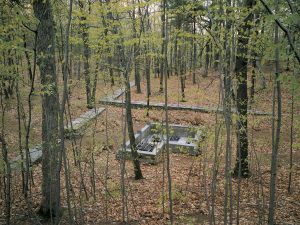
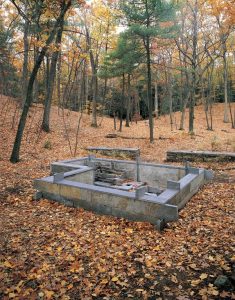
Woodland Garden is meant to be discovered, stumbled upon, as one travels along the forest trail. The site is defined with low stone walls that serve as both threshold and boundary, referring to the abandoned stone walls and foundations found throughout New England’s reforested landscapes. The sculptural element is sited in a hollow between two small hills in the landscape. Low split-stone slabs and a cut capstone rise two feet above the ground plane and define the upper edge of a chamber that extends four feet below the ground. The sunken chamber contains sculptural layers of cut granite and cast bronze. Over one hundred planted indigenous silver beech and red maple trees, along with wild blueberry and ferns, were planted as a part of the project to blend into the existing woodland flora.

The project was sponsored by the National Endowment for the Arts, LEF Foundation, Davis Museum and Cultural Center, and the Massachusetts Council on the Arts.

The Restoration

Wellesley college restoration 2Wellesley College's Davis Museum commissioned Arts Management Services LLC on several occasions to remove graffiti and repair other damage. The remote location of the sculpture lends itself to being abused by students - both college and high school - as a favorite hangout and party area. Damage often resulted especially when the parties included drinking and a camp fire.

After what looked like regular annual repair bills, I suggested signage and a program that encouraged students to learn about the sculpture and respect it. This has resulted in excellent results with no damage since.

  • Related Articles
  • Ceramic Restoration
  • Framed Artwork Restoration in Delray Beach
  • Tile Art Restoration in Manila
  • Graffiti Removal

The restoration work involved removing burnt remains of campfires, graffiti on the walls, replacing moss, straightening bronze elements, cleaning and re-pinning rocks, repairing a cracked slab of schist, and replacing a bronze element that had been removed and lost, presumably as a souvenir. I also taught students to carry out annual maintenance on this outdoor sculpture garden.

Filed Under: Restoration Tagged With: Art Restoration, Arts Management Services LLC, Michael Singer, restoration, Robert Hannum, sculpture restoration

  • « Go to Previous Page
  • Page 1
  • Page 2
  • Page 3
  • Page 4
  • Page 5
  • Go to Next Page »
design_1164421_26862579_3962546_sourcefile_03

© 2009-2026 Arts Management Services LLC. All Rights reserved. | Privacy | Terms | Webmaster Midnightsons Designs